“One one coco full basket.” It is a familiar Caribbean saying that speaks to the value of collective effort. It is also a fitting reflection of what it will take to advance the region's energy transition: countries, institutions, development partners and communities working together to turn shared opportunities into tangible results.
The Caribbean's relationship with the ocean has always been central to its identity and economic development. Our seas connect our islands, sustain livelihoods, support trade and tourism, and provide the foundation for important economic activities. Yet the potential of our marine resources to contribute to the region's renewable energy transition remains largely underexplored.
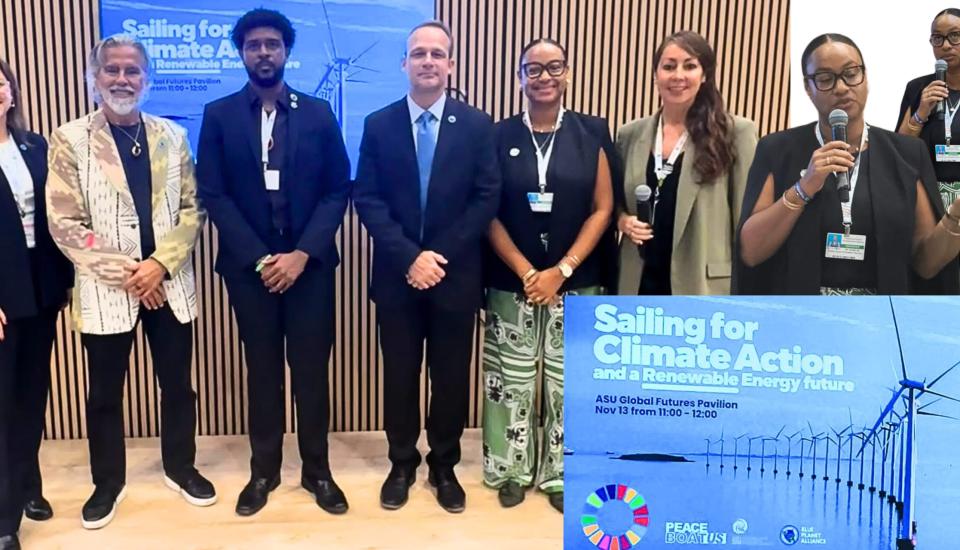
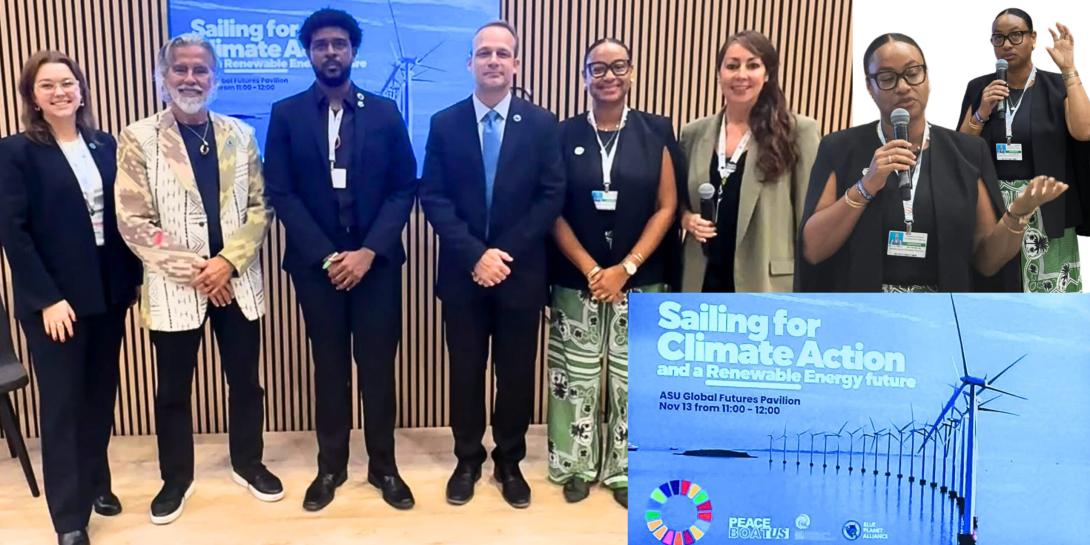
At COP31 in Antalya, Türkiye, Kiesha Farnum, Head of Partnerships and Programmes at the Caribbean Centre for Renewable Energy and Energy Efficiency (CCREEE), highlighted these opportunities during the session, “Sailing for Climate Action and a Renewable Energy Future”, held in partnership with Peace Boat US and Blue Planet Alliance.
Her contribution focused on an important consideration: advancing the Caribbean's energy transition requires more than technology. It requires investment in people, stronger institutional partnerships, regional expertise and the capacity to translate opportunities into viable projects.
Investing in the people behind the energy transition
CCREEE's partnership with Blue Planet Alliance (BPA) demonstrates how international collaboration can create practical opportunities for Caribbean talent.
In 2025, BPA sponsored three interns to participate in CCREEE's Energy Report Card data collection cohort, providing young professionals with hands-on experience in energy research, data collection and the priorities shaping the region's energy transition.
CCREEE also participates in BPA's twice-yearly fellowships, which bring together representatives from utilities, governments, regulators and civil society. These engagements create opportunities for stakeholders with different institutional responsibilities and priorities to exchange knowledge, build trust and develop a shared understanding of the energy transition.
Through initiatives such as the Women in Renewable Energy (WIRE) Fellowship, CCREEE is also strengthening pathways for emerging leaders. WIRE fellows develop and implement Youth Call to Action projects, translating leadership development into practical advocacy and community engagement.
The objective is to move beyond youth participation towards youth ownership, leadership and measurable contributions to the region's development.
The Caribbean: Small Island Developing States, Large Ocean States
The Caribbean's maritime spaces represent a significant development opportunity. Across the region, Exclusive Economic Zones are approximately 28 times the size of the land area.
This presents opportunities to diversify energy systems, strengthen energy security, support economic development and explore emerging industries. However, realising this potential requires reliable scientific evidence, specialised technical expertise, enabling policies, investment and responsible ocean governance.
CCREEE is advancing this work through three complementary regional initiatives.
1. Regional Offshore Wind Strategy and Roadmap (ROWSAR)
With support from the United Kingdom's Foreign, Commonwealth & Development Office (FCDO), and strategic guidance from the Inter-American Development Bank (IDB) and the Caribbean Development Bank (CDB), CCREEE is leading regional efforts to explore offshore wind as a potential contributor to the Caribbean's renewable energy transition.
The Regional Offshore Wind Strategy and Roadmap (ROWSAR) has assessed offshore wind potential across 21 Caribbean countries, identifying five priority countries for further exploration: Antigua and Barbuda, Barbados, Jamaica, Suriname, and Trinidad and Tobago.
The initiative is advancing the identification of a Lighthouse Project that can demonstrate the region's offshore wind potential and establish a pathway for future development.
Building regional expertise is equally important. The Offshore Wind Champions Course recorded 31 completions, with women representing 58% of graduates. Two study tours to Scotland also provided participants with practical exposure to the offshore wind industry.
Beyond electricity generation, offshore wind presents opportunities to develop new industries, create local employment, strengthen technical skills and facilitate participation by existing maritime sectors.
Through ROWSAR, CCREEE and its development partners are building the evidence, expertise and partnerships necessary to move offshore wind from resource potential towards investment-ready opportunities.
2. EUROCLIMA Caribbean Multi-Country Action Plan – Wave Energy
The European Union, through the EUROCLIMA Caribbean Programme and its Global Gateway strategy, is supporting the development of the Caribbean's marine renewable energy potential through the Multi-Country Action Plan (M-CAP).
With the United Nations Development Programme (UNDP) serving as the implementing agency for the marine energy actions and CCREEE providing regional technical leadership and implementation support, the initiative is assessing wave energy potential across Antigua and Barbuda, Barbados, Grenada, Saint Vincent and the Grenadines, and Saint-Barthélemy.
The programme has a US$1.2 million allocation for the CARICOM Member States component, with supplementary funding provided for the Saint-Barthélemy assessment.
The initiative will examine oceanographic resources, suitable technologies, grid integration, environmental considerations and financial viability. This includes assessing technology readiness, infrastructure requirements, potential development sites and the financing arrangements that could support future projects.
A coordinated regional approach will allow participating jurisdictions to share marine data, pool technical expertise, strengthen institutional capacity and develop common investment pathways while accounting for individual national priorities.
The programme also recognises the importance of developing Caribbean expertise in this emerging sector, including opportunities for young researchers, universities and technical professionals.
The objective is to establish the scientific evidence, institutional readiness and investment foundations required to determine whether wave energy can become a viable contributor to the region's renewable energy mix.
3. Greening Caribbean Ports Programme (GCPP)
Caribbean ports are economic lifelines. They underpin international trade, tourism, food security, energy supply and connectivity between islands and international markets. However, many face high energy costs, dependence on imported fossil fuels, ageing infrastructure, limited grid capacity and increasing exposure to climate-related risks.
The Greening Caribbean Ports Programme (GCPP) is designed to support a more coordinated approach to port decarbonisation across the region.
The programme is led by CCREEE in partnership with the Port Management Association of the Caribbean (PMAC), with CARICOM serving as the executing agency under the CARICOM-Spain Joint Fund. Its donor is Spanish Cooperation, through the Spanish Agency for International Development Cooperation (AECID).
Phase I will initially support three strategic ports in Antigua and Barbuda, Barbados and Saint Lucia. The proposed 36-month phase has a budget of US$350,000, with the Phase I grant financing status to be confirmed.
The programme will establish practical, phased pathways towards lower-emission, energy-efficient and climate-resilient port operations.
Its initial activities will include port energy and emissions assessments, infrastructure and operational diagnostics, decarbonisation modelling, and the development of port-specific transition roadmaps.
Potential interventions will include shore power, port electrification, renewable energy integration, energy storage and lower-carbon fuels.
Knowledge exchange is also an important component, including a planned study tour to Spain to examine practical experience in port decarbonisation, shore power, alternative fuels and integrated port energy systems.
Importantly, Phase I focuses on technical assistance and project preparation rather than infrastructure deployment. Its purpose is to establish the evidence, assess feasibility and identify investment priorities that can guide future financing and implementation.
The programme will also strengthen institutional capacity, support policy and regulatory alignment, and develop monitoring, reporting and verification approaches to track energy use and emissions reductions.
A just and inclusive maritime transition is central to this work. Port workers, shipping operators, local businesses, coastal communities, women and young people must be considered as Caribbean countries explore new approaches to port operations and maritime development.
Connecting the blue economy with a just energy transition
Across all three initiatives, a common priority is ensuring that the development of the Caribbean's blue economy creates opportunities for its people.
Offshore wind, wave energy and greener ports will require new technical capabilities, institutional readiness and stronger connections between the energy and maritime sectors.
Women and young people must have access to the training, professional pathways and technical expertise needed to participate in these emerging industries. Port workers, maritime operators, fisheries and coastal communities must also be considered in the planning and implementation of new interventions.
This is why partnerships with organisations such as Blue Planet Alliance and engagement with programmes such as Peace Boat's Youth for the SDGs are important. They connect young people with international perspectives, practical learning opportunities and networks that can help them contribute to their countries and communities.
For CCREEE, the objective is not simply to increase participation but to create meaningful opportunities for Caribbean people to influence, shape and benefit from the region's energy transition.
Building a regional pathway through partnerships
The three blue economy initiatives demonstrate that the Caribbean's energy future is closely connected to its maritime economy. They also reinforce the importance of coordinated regional approaches that allow countries to share knowledge, strengthen technical capacity and engage more effectively with technology developers, development partners and investors.
As Farnum highlighted during the COP31 session, the ocean is not simply something the Caribbean must protect from climate change. It is also an important part of the solution.
Unlocking that potential, however, requires sound evidence, responsible ocean governance, institutional coordination and sustained investment in both technology and people.
Through its partnerships with the FCDO, IDB, CDB, European Union, UNDP, Spanish Cooperation, AECID, CARICOM, PMAC, Blue Planet Alliance and Peace Boat US, CCREEE continues to connect regional priorities with the technical expertise, collaboration and resources needed to advance sustainable energy development.
The task ahead is to move beyond individual projects towards coordinated regional approaches that strengthen energy security, support economic diversification and deliver lasting benefits for Caribbean people and communities.
"One one coco full basket." The Caribbean's blue energy future will be built through collective effort, strong partnerships and sustained investment in the people who will deliver it.


Latest News
-
From G.I.R.L.S. Bingo to Renewable Energy Champions: CCREEE Inspires Young Girls in Girl Guide Association 
From G.I.R.L.S. Bingo to Renewable Energy Champions: CCREEE Inspires Young Girls in Girl Guide Association
-
WIRE Study Tour Connects Caribbean Women with Clean Energy Innovation in Canada 
WIRE Study Tour Connects Caribbean Women with Clean Energy Innovation in Canada
-
ECOWAS–EU Energy Partnership Forum Showcases Facility for Energy Transition in Food Systems ECOWAS–EU Energy Partnership Forum Showcases Facility for Energy Transition in Food Systems
-
ECREEE and Partners Advance Regional Clean Cooking Agenda at ReCCAWA Consultative Meeting in Cotonou ECREEE and Partners Advance Regional Clean Cooking Agenda at ReCCAWA Consultative Meeting in Cotonou
-
ECOWAS and the European Union present two regional energy programmes in West Africa in Cotonou 
ECOWAS and the European Union present two regional energy programmes in West Africa in Cotonou
-
ECREEE holds its 5th EDCC Meeting 
ECREEE holds its 5th EDCC Meeting
-
ECREEE Advances China–Africa Cooperation on Sustainable Cooling 
ECREEE Advances China–Africa Cooperation on Sustainable Cooling
-
Three Months of Growth, Learning and Leadership: Celebrating the WIRE Fellowship Journey 
Three Months of Growth, Learning and Leadership: Celebrating the WIRE Fellowship Journey
-
Charging the Transition: CCREEE Puts Electric Mobility in Focus at COP31 
Charging the Transition: CCREEE Puts Electric Mobility in Focus at COP31
-
FROM AMBITION TO IMPLEMENTATION: FINANCING THE CARIBBEAN’S TRANSFORMATION 
FROM AMBITION TO IMPLEMENTATION: FINANCING THE CARIBBEAN’S TRANSFORMATION
-
CCREEE Brings Gender, Youth and Inclusive Leadership into the Energy Transition Discussion at COP31 
CCREEE Brings Gender, Youth and Inclusive Leadership into the Energy Transition Discussion at COP31
-
ECREEE Contributes to Continental Certification Framework for Energy Efficiency Professionals and ESCOs 
ECREEE Contributes to Continental Certification Framework for Energy Efficiency Professionals and ESCOs