Status of the Global Network of Regional Sustainable Energy Centers (GN-SEC)
Given the moderate growth rates of sustainable energy technology markets and investments in many developing countries, it is clear that SDG 7 (affordable and clean energy), SDG 9 (industry, innovation and infrastructure), SDG 12 (responsible consumption and production), and SDG 13 (climate action) are unlikely to be achieved by 2030 under business-as-usual scenarios. Achieving these goals will require greater economies of scale, accelerated implementation, and systemic change. In this context, regional cooperation, South–South collaboration, and triangular partnerships can serve as critical accelerators.
To address the missing link of regional clean energy cooperation in developing countries, UNIDO launched the Global Network of Regional Sustainable Energy Centres (GN-SEC) programme in 2010. Through a joint platform, UNIDO assists regional economic communities (RECs) in establishing and operating sustainable energy centres that drive and accelerate the energy transition "from the region for the region." The GN-SEC represents an innovative South-South and triangular multi-stakeholder partnership.
Operating centres
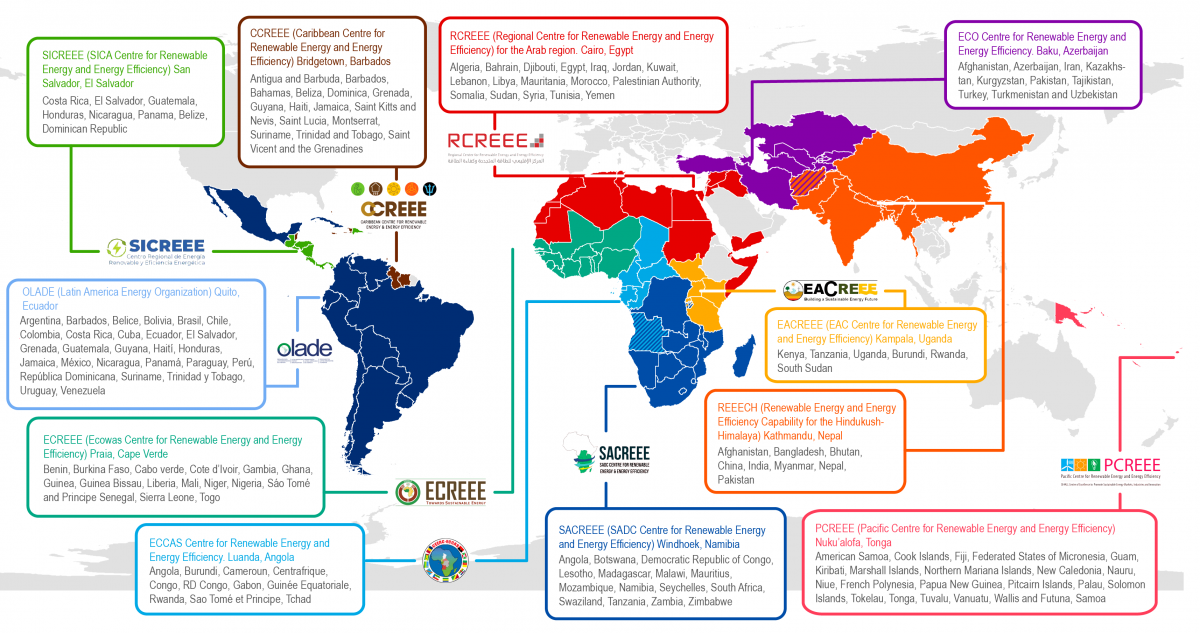
As of today, the Global Network of Regional Sustainable Energy Centres (GN-SEC) comprises ten operational centres across the Arab and African regions (ECOWAS, SADC, EAC, ECCAS, and the Arab League), Asia and the Pacific (SPC, ICIMOD, ECO), and Latin America (CARICOM, SICA). The centres are officially endorsed by more than 120 Ministers of Energy and/or Heads of State, and together serve 41 out of 46 Least Developed Countries (LDCs) and 35 out of 39 Small Island Developing States (SIDS). To further broaden its geographic reach, a joint declaration on GN-SEC cooperation was signed between the Latin American Energy Organization (OLADE) and UNIDO in 2021.

The GN-SEC platform
The global GN-SEC platform, hosted by UNIDO in Vienna, Austria, facilitates joint coordination, learning, programs, events, and initiatives between the centres and various regions. It provides a "virtual" maker-space for South-South and triangular cooperation activities and joint project proposals. For example, SIDS share similar challenges and opportunities regarding electric mobility and storage solutions, while LDCs in Sub-Saharan Africa share a common interest in renewable energy mini-grid development for rural electrification and productive uses. The GN-SEC platform has a Steering Committee (SC), which comprises the regional centres, UNIDO, and the core donors. The virtual GN-SEC platform www.gn-sec.net brings together the information sources of all centres in real-time.
The GN-SEC Centres
- ECOWAS Centre for Renewable Energy and Energy Efficiency (ECREEE) in partnership with ECOWAS
- Regional Centre for Renewable Energy and Energy Efficiency (RCREEE) in partnership with the Arab League
- SADC Centre for Renewable Energy and Energy Efficiency (SACREEE) in partnership with SADC
- East African Centre for Renewable Energy and Energy Efficiency (EACREEE) in partnership with EAC
- Pacific Centre for Renewable Energy and Energy Efficiency (PCREEE) in partnership with SPC
- Caribbean Centre for Renewable Energy and Energy Efficiency (CCREEE) in partnership with CARICOM
- Renewable Energy and Energy Efficiency Capacity for the Hindu Kush Himalaya (REEECH), in partnership with ICIMOD
- SICA Centre for Renewable Energy and Energy Efficiency (SICREEE), in partnership with SICA
- Centre for Renewable Energy and Energy Efficiency for Central Africa (CEREEAC) in partnership with ECCAS
- ECO Clean Energy Centre (CECECO), in partnership with ECO
- Joint cooperation with the Latin American Energy Organisation (OLADE)
Transitioning towards a new global business model
In line with the SDGs, the GN-SEC works towards a new global business model that enables the production of more goods and services required by a growing world population while using fewer resources and producing less waste and pollution. There is a growing trend towards circular economy policy concepts in response to the increasing scarcity and price volatility of raw materials, including fossil fuels, as well as the need to internalize the costs of environmental externalities such as air, soil, and water pollution and climate change caused by global greenhouse gas emissions.
The deployment of sustainable energy technologies is considered an effective tool to simultaneously and comprehensively address economic/industrial productivity and competitiveness, energy security, energy access/affordability, and the negative externalities of conventional energy systems (e.g., GHG emissions, local pollution). In this context, developing countries have also introduced far-reaching targets for scaling up renewable energy and energy efficiency technology markets (e.g., NDCs) over the coming decades. Most of these efforts are closely aligned with economic, industrial, and environmental policies targeting increased competitiveness, productivity, inclusiveness, sustainability, and resilience to climate change impacts.
Despite growing investments over the past decade, sustainable energy markets have not reached economies of scale, particularly in low-income developing countries. In the energy sector, the deployment of renewable energy and energy efficiency solutions remains hindered by a broad range of barriers and shortcomings related to policy and regulation, fiscal and non-fiscal incentives, technical limitations, economics, finance, capacity, quality infrastructure, R&D and innovation frameworks, knowledge, and awareness.
Moreover, in many developing countries, the inability of the domestic private sector to supply quality sustainable energy products and services at competitive prices has become a bottleneck for market uptake. The domestic manufacturing and servicing sector remains weakly developed, and the growing demand remains underserved by international suppliers and supply chains due to high market entry costs and risks. Furthermore, policies and technology transfer programs tend to focus on creating demand for sustainable energy products and services while neglecting supplier-oriented actions focused on strengthening domestic innovation systems, productive industrial capacities, and entrepreneurship.
Such trends raise concerns regarding the inclusiveness of technology transfer processes. While this situation offers opportunities, it also bears the risk that the local value creation and employment effects of such investments remain low and are not sustained in the long run. Particularly in least developed countries (LDCs), even basic equipment and services (e.g., consulting, energy auditing, installation, maintenance) continue to be imported. The absence of domestic suppliers and service providers calls into question the long-term sustainability of renewable energy investments already undertaken in various developing countries. Furthermore, the lack of domestic R&D and entrepreneurship hinders the commercialization of sustainable energy solutions adapted to the specific realities of LDCs and Small Island Developing States (SIDS).